In EventKey, an Event Cancellation Policy establishes the contractual terms, penalty timelines, and financial obligations enforced when an event organizer or client cancels a confirmed event. Defining standardized cancellation rules safeguards property revenue from late cancellations, establishes operational consistency, and provides event organizers with clear contractual expectations. Through the 2-step Add Cancellation Policy wizard, administrators configure basic policy metadata, assign general ledger charge types for penalty revenue recognition, define multi-tiered penalty windows with start/end offset day calculations, apply flat-fee or percentage charges across specific revenue components (Space, Package, Group, Deposit), and manage active/inactive visibility. Once published, cancellation terms automatically link to Event Records, populate into event proposals, and print on Banquet Event Orders (BEOs).
Operational Prerequisites
Before configuring a cancellation policy, verify that foundational accounting data is established:
Charge Type Setup: The accounting posting code used to assess cancellation penalty fees (e.g., Cancellation Charge, Banquet_Wedding Function Room Rental_Setup-Revenue) must be configured in system administration under financial settings so revenue is properly routed to the general ledger upon event cancellation.
Configuration Guide: Creating a Cancellation Policy
System Navigation Path
Home > Event Administration > Policies > Cancellation Policies > + Add New
Step
Action
Platform Guidance & Operational Details
Access Cancellation Policies
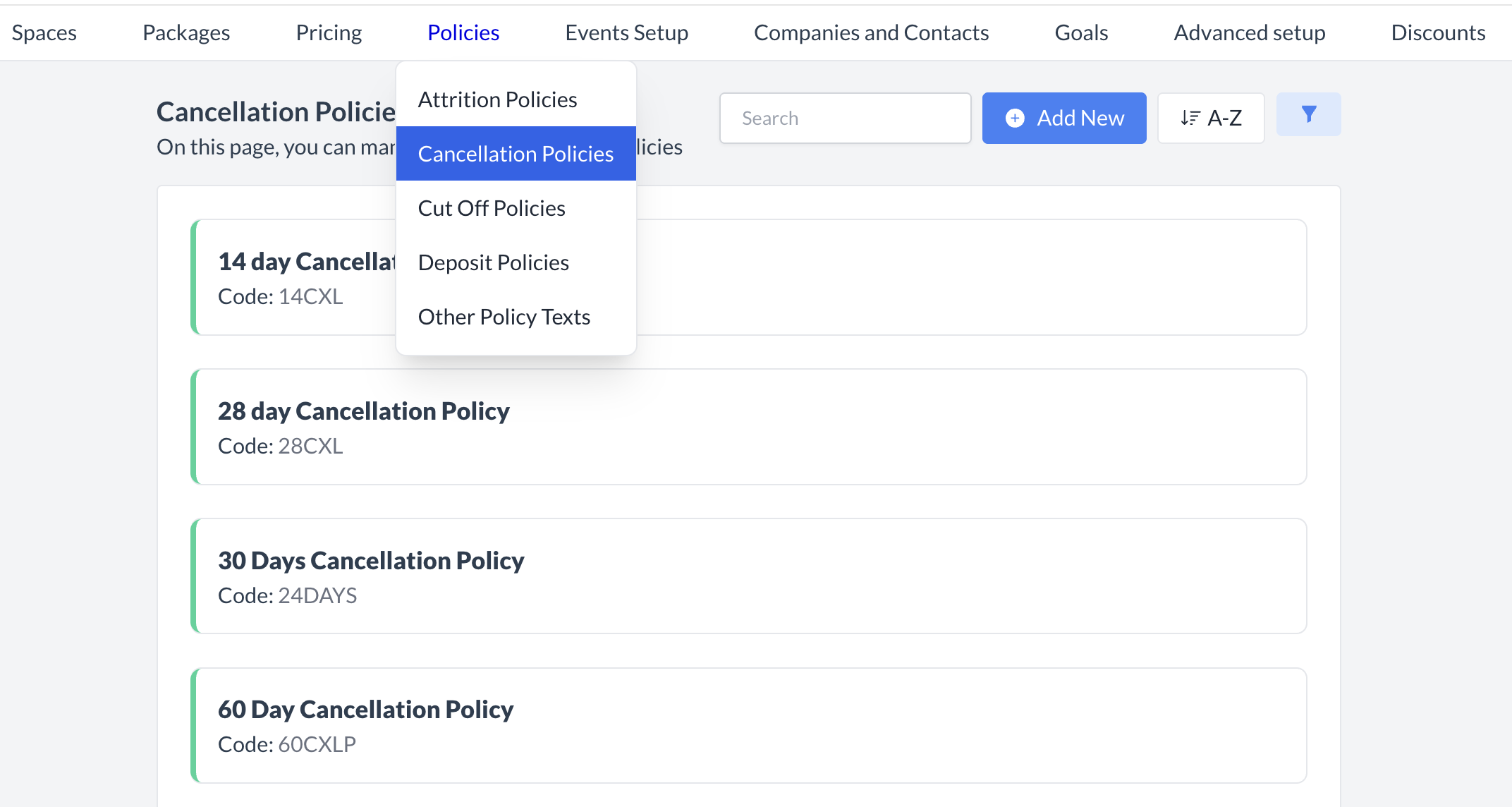
In EventKey Administration, hover over the Policies tab in the main navigation bar and select Cancellation Policies from the dropdown menu.
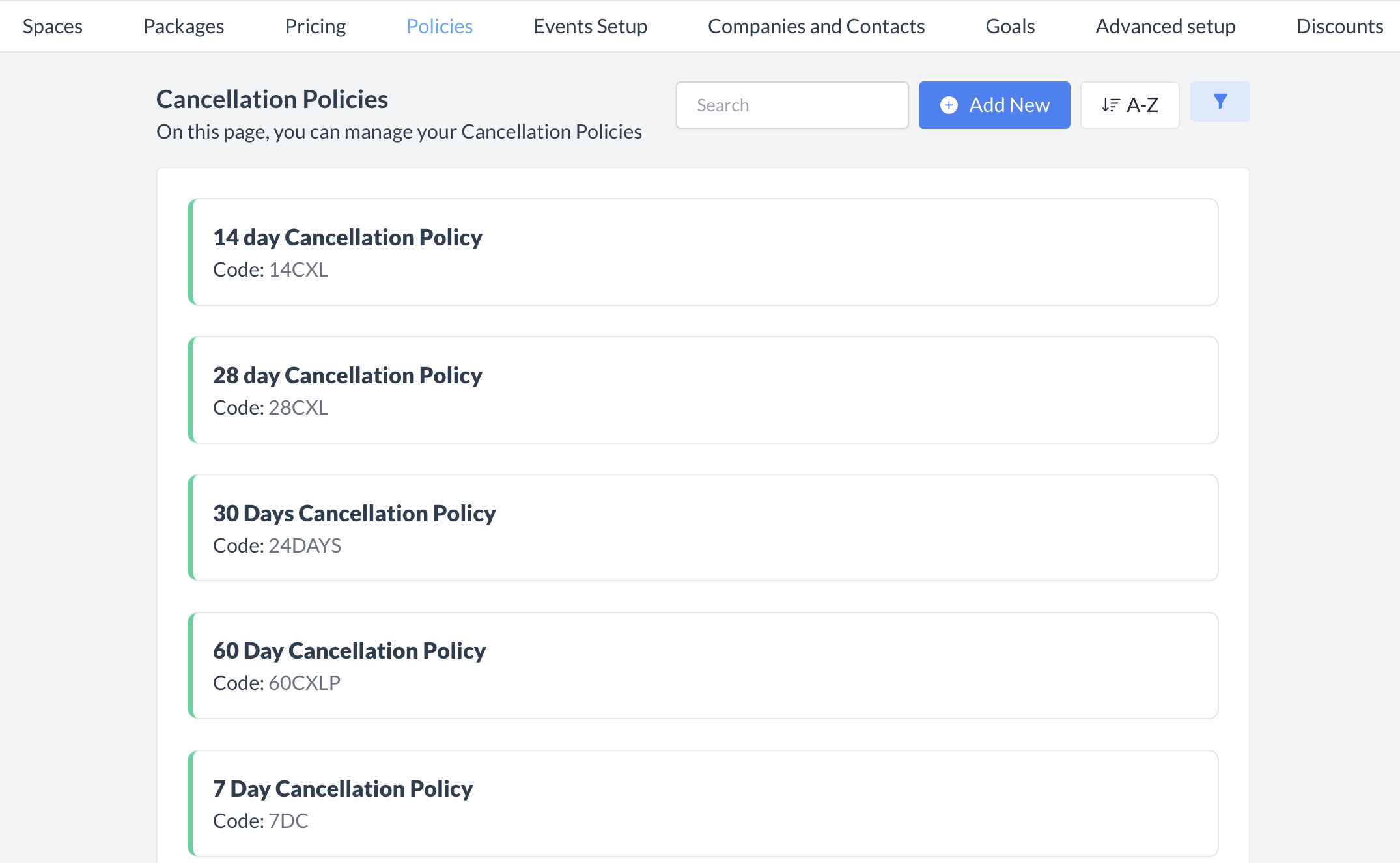
Opens the Cancellation Policies directory displaying all existing policies, tracking codes, search, sort, and status controls.
Initiate Policy Creation
Click the blue + Add New button located in the upper-right corner.
Opens the 2-step Add Cancellation Policy wizard defaulting to Step 1: Basic Data with the Active toggle enabled in the header.
Step 1: Configure Basic Data
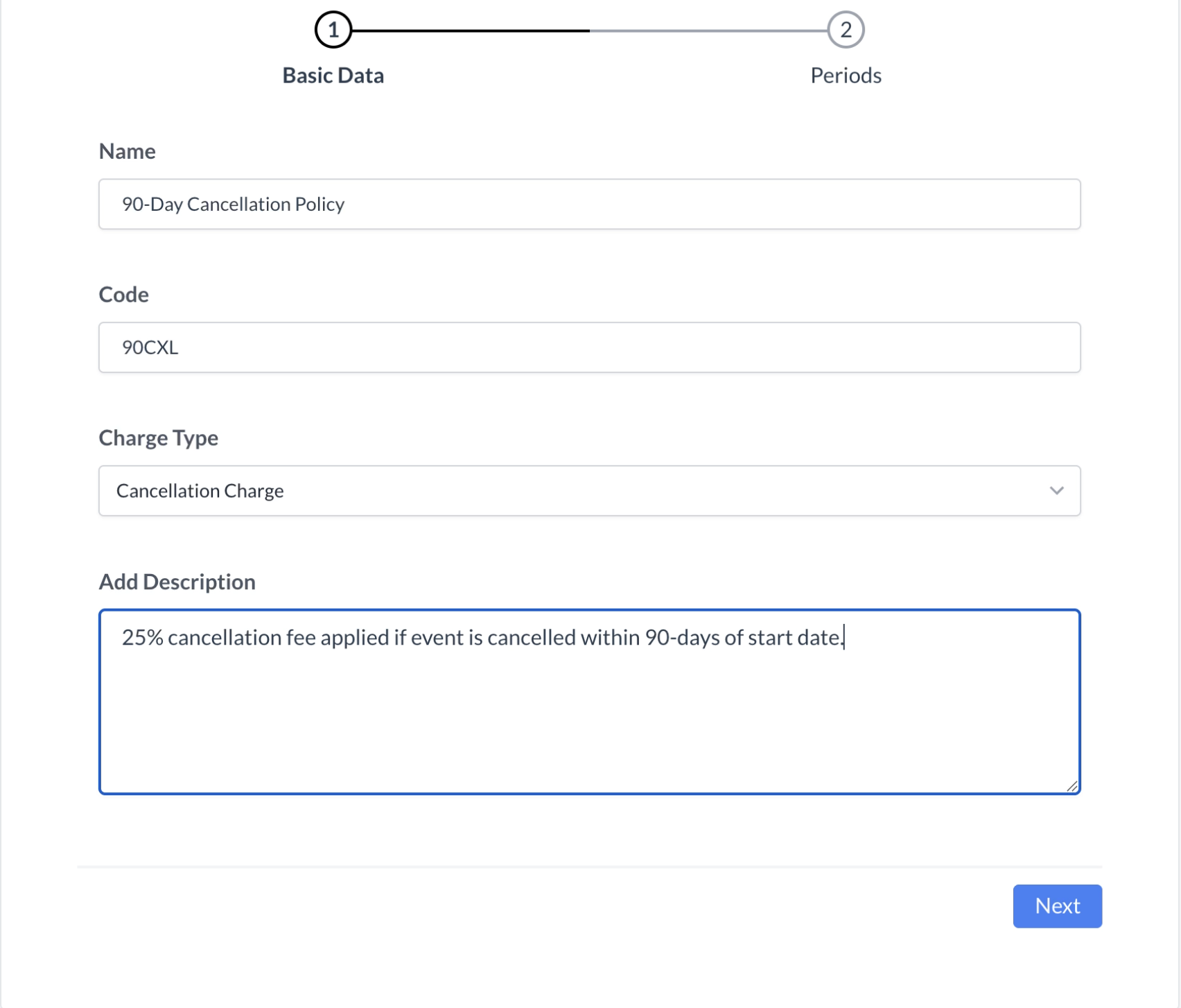
Enter the policy name (e.g., 90-Day Cancellation Policy), assign a unique alphanumeric code (e.g., 90CXL), select the charge type (e.g., Cancellation Charge), and provide an operational description (e.g., 25% cancellation fee applied if event is cancelled within 90-days of start date.).
Establishes the display name, system tracking code, accounting revenue mapping, and contractual conditions. Click the blue Next button.
Step 2: Add Cancellation Period
On the Periods screen, click the blue plus + button in the center of the table.
Launches the Cancellation Period modal dialog.
Select Calculation Types
Click the Calculation Types dropdown and select the event components subject to the penalty (e.g., select Space and Package).
Designates whether the penalty applies across Space rental fees, Package offerings, Group blocks, or Deposit totals.
Configure Date Triggers & Offsets
Set Start Calculation Type to Arrival Date with an Offset Start of -90. Set End Calculation Type to Arrival Date with an Offset End of 0.
Establishes the penalty window starting 90 days prior to event arrival and concluding on the day of arrival.
Define Penalty Type & Value
Select Percentage or Amount from the Type dropdown and enter 25 in the Value field.
Applies a 25% or fixed cancellation charge against the selected revenue categories.
Save Cancellation Period
Click the blue Save button in the lower-right corner of the modal.
Closes the modal and stages the penalty rule row in the Step 2 table, showing Calculation Types, Start/End calculation points, offsets, and penalty value.
Commit Full Policy
Review the staged period row and click the blue Save button in the lower-right corner.
Commits the policy to the database, displays a green notification banner (Success: Saved Successfully), and returns to the active policy directory.
📷 VISUAL CALLOUT:
Cancellation Policies Catalog & Add New Initiation
(Left) The Policies dropdown menu displaying Attrition Policies, Cancellation Policies, Cut Off Policies, Deposit Policies, and Other Policy Texts; (Right) The Cancellation Policies catalog displaying existing policies (e.g., 14-day, 28-day, 30-day, 60-day, 7-day), search box, sort controls (A-Z), and the blue + Add New button.
Policies Dropdown Menu
Cancellation Policies Catalog
Detailed Screen & Field Breakdown
Step 1: Basic Data Configuration
Active Toggle: Located in the upper-right corner; enables immediate availability across event booking workflows upon saving.
Name*: Required contractual title of the policy (e.g., 90-Day Cancellation Policy, 60 Day Cancellation Policy).
Code*: Required unique alphanumeric code used for internal auditing, reporting, and BEO alignment (e.g., 90CXL, 60CXLP).
Charge Type*: Required dropdown selecting the financial general ledger code mapped to post cancellation penalty revenue (e.g., Cancellation Charge).
Add Description: Multi-line text field detailing penalty thresholds and contractual terms (e.g., "25% cancellation fee applied if event is cancelled within 90-days of start date.").
📷 VISUAL CALLOUT:
Step 1: Basic Data Configuration Screen
Form screen displaying the Name (90-Day Cancellation Policy), Code (90CXL), Charge Type dropdown selected to Cancellation Charge, and the Description field populated with the 25% within 90-day terms.
Basic Data Configuration
Step 2: Periods (Penalty Rules Configuration)
Clicking the blue plus + button opens the Cancellation Period modal:
Calculation Types Dropdown: Multi-select checklist identifying the revenue streams assessed:
Deposit: Calculates penalty based on required or collected deposit amounts.
Group: Assesses charges against sleeping room block commitments.
Package: Assesses charges against food, beverage, or audio-visual packages.
Space: Assesses charges against function room hire rates.
Start Calculation Type & Offset Start:
Reference Dropdown: Select Arrival Date or Contract Due Date.
Offset Start (- / +): Number of days relative to the calculation point. Enter negative values to indicate days prior to arrival (e.g., -90 represents 90 days before event arrival).
End Calculation Type & Offset End:
Reference Dropdown: Select Arrival Date or Contract Due Date.
Offset End (- / +): Number of days relative to the calculation point (e.g., 0 represents the day of event arrival).
Type & Value:
Type Dropdown: Select Percentage (percentage of applicable revenue) or Amount (flat monetary penalty).
Value Field: Numeric input specifying the percentage rate (e.g., 25%, 100%) or flat currency sum.
Staged Period Table Summary:
Displays columns for Calculation Types, Start Calculation Type, Offset Start, End Calculation Type, Offset End, Value, and an edit pencil icon to modify staged rules prior to saving.
If a policy is seasonal, superseded by new contract terms, or temporarily retired, administrators can adjust its status without removing historical event data:
Workflow
Step-by-Step Procedure
System Impact
Inactivating a Policy
Navigate to Policies > Cancellation Policies.
Click on the target policy card (e.g., 28 day Cancellation Policy).
In the policy header, toggle the Active switch to OFF.
The change is saved automatically. The policy is hidden from new event booking selection menus and marked with a grey indicator bar, while existing event bookings retain their contracted terms.
Reactivating a Policy
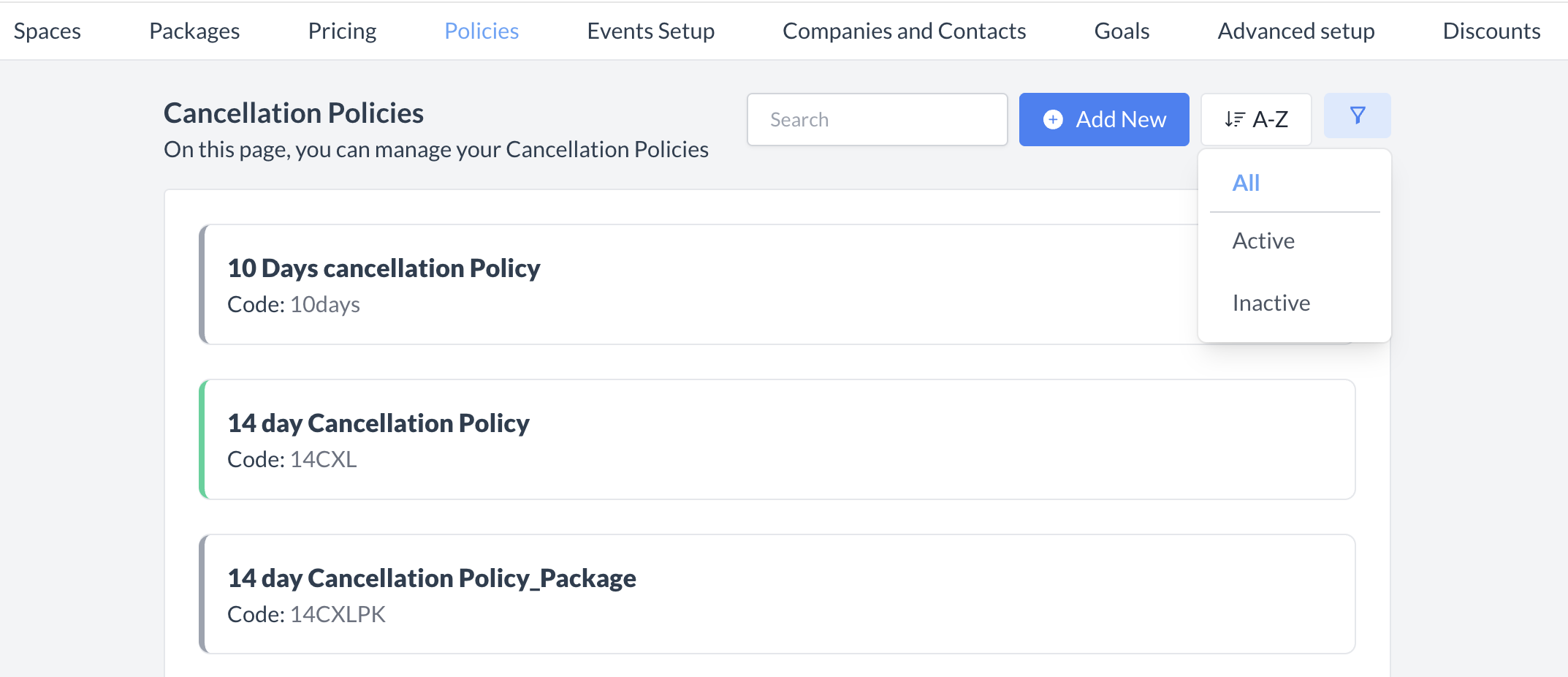
In the Cancellation Policies directory, click the status filter dropdown in the upper-right corner and select Inactive (or All).
Locate the inactive policy (marked with a grey sidebar) and click to open.
In the header card, toggle the Inactive switch to Active (ON).
Instantly restores the policy with a green sidebar indicator, returning it to active selection in event booking and proposal workflows.
📷 VISUAL CALLOUT:
Active vs. Inactive Policy Indicators & Filter Menu
Catalog screen comparing active policies (green vertical sidebar) against inactive policies (grey vertical sidebar), alongside the top-right status filter dropdown (All, Active, Inactive).
Active policies (green vertical sidebar) and Inactive policies (grey vertical side bar)
Downstream UI & Operational Touchpoints
Once created and activated, Cancellation Policies automatically integrate into operational workflows across EventKey:
Event Creation Wizard (Step 4: Guarantee Information): When creating a new event, operators select the active policy from the Cancellation Policy dropdown menu.
Event Record (Reservation Console): On existing event records, the contracted policy displays under Guarantee Information. Clicking the Edit (pencil) icon allows authorized managers to modify or reassign the policy if renegotiated.
Banquet Event Orders (BEOs): The policy terms automatically print in the Event Cancellation Policy table on the BEO, itemizing the Period Range, Percentage, calculated Fee, and applicable Fee Type (e.g., Space, Package) to ensure legal and operational clarity.