Target Roles: Event Sales Managers, Catering Directors, Finance Directors, Night Auditors, Systems Administrators
Last Updated:
Executive Overview
In EventKey, an Event Deposit Policy (Advance Deposit Terms) outlines the schedule, terms, and payment milestones by which an event client or meeting organizer is required to remit payment in advance of their event. Establishing advance deposit terms secures room and space commitments, mitigates financial exposure from late cancellations, and provides transparency regarding payment expectations. System administrators and event coordinators can configure single-milestone deposits or multi-tiered payment schedules (e.g., staggered deposits due at 90, 60, and 30 days prior to arrival), specify whether deposits include taxes, link rules to specific revenue components (Space, Package, Group), define legal disclaimers, and enable automated night audit collection through integrated payment gateways. Once published, deposit terms seamlessly integrate into the Event Creation wizard, Event Records, Event Quotation Letters, and Banquet Event Orders (BEOs).
Configuration Guide: Creating an Advance Deposit Policy
System Navigation Path
Home > Event Administration > Policies > Deposit Policies > + Add New
Step
Action
Platform Guidance & Operational Details
Access Deposit Policies
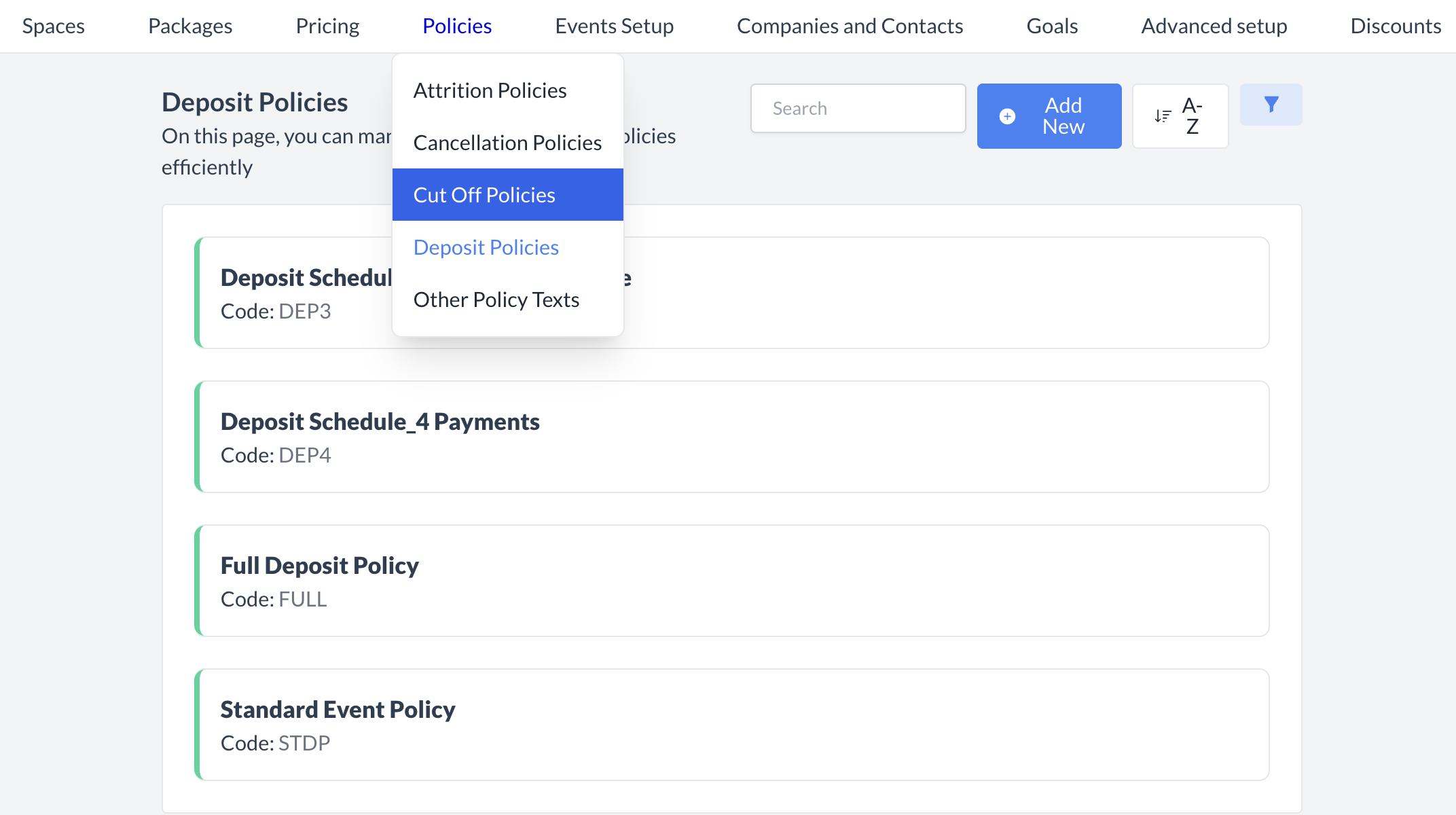
In EventKey Administration, hover over the Policies tab in the main navigation menu and select Deposit Policies from the dropdown menu.
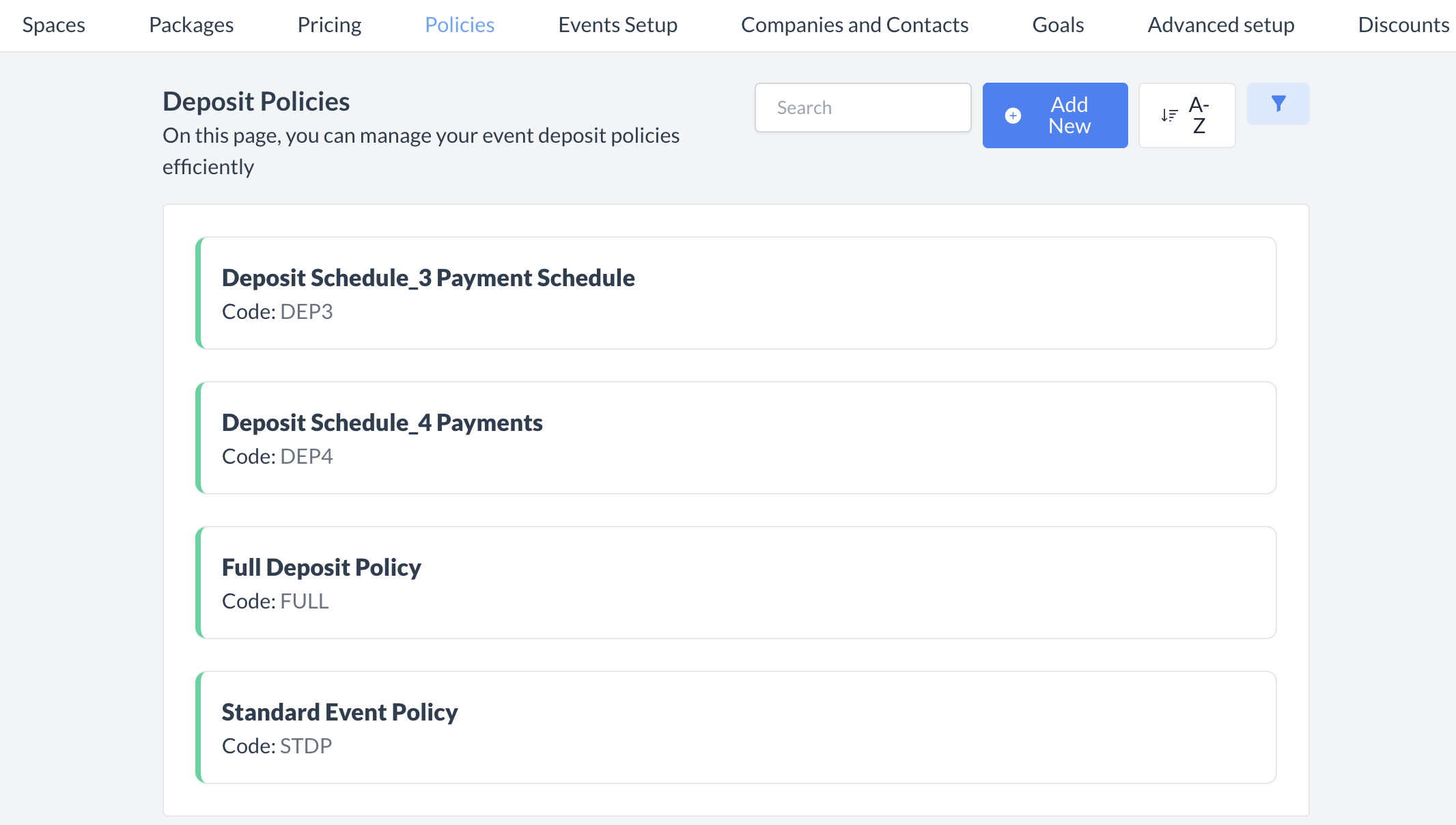
Opens the Deposit Policies directory displaying all existing deposit policies, internal codes, search, sort, and status controls.
Initiate Creation
Click the blue + Add New button located in the upper-right corner next to the search and sort tools.
Launches the Add Advance Deposit Terms configuration screen with the Active toggle enabled by default.
Enter Basic Policy Info
In the Name field, enter a descriptive title (e.g., Standard Event Policy or Deposit Schedule, 3 Payment Schedule). In the Code field, enter a unique alphanumeric code (e.g., STDP or DEP3).
Establishes the display title and unique identifier used across reporting, event contracts, and system records.
Select Calculation Types
Click the Deposit Calculation Types dropdown menu and select the event revenue streams subject to the deposit (e.g., select Space and Package).
Designates which revenue areas are included in the deposit baseline (Space rental, catering/AV packages, or sleeping room group blocks).
Configure Calculation Toggles
Set the calculation and collection toggles as required:
Include Taxes in deposit calculation: Toggle ON if deposit amounts must calculate against gross totals including taxes.
Auto Collect Deposit On NA: Toggle ON to automate scheduled collections during the Night Audit run.
Automating night audit collection requires an active credit card tokenized on the event file and an integrated payment gateway.
Configure Deposit Term Rules
Click the blue + Add Rule button to create deposit milestones:
Deposit Lead Days: Enter days before the reference point (e.g., 75 or multi-tiered 90, 60, 30).
Date Type: Select Check-in Date or Tentative Date.
Type: Select Percentage or Amount.
Value: Enter the required percentage or flat monetary amount (e.g., 50% or staggered 50%, 75%, 100%).
Defines the timeline and value due for advance payment collection. Click + Add Rule to append additional milestones for staggered payment schedules.
Add Deposit Disclaimer
In the Deposit Disclaimer text area, enter standard contractual conditions (e.g., "Event deposit due 100% in full 30-days prior to event start date. First deposit of 50% due 90-days prior to event start." or "50% deposit on event is required to be paid in full 75-days prior to event start date.").
Concise statement summary (up to 250 characters) that populates directly onto client-facing Event Quotation Letters.
Save & Deploy
Click the blue Save button in the lower-right corner of the screen.
Commits the policy configuration to the database, displays a green notification banner (Success: Saved Successfully), and publishes the policy to the active directory.
📷 VISUAL CALLOUT:
Deposit Policies Directory & Navigation Menu
(Left) The Policies dropdown menu expanded to show Attrition Policies, Cancellation Policies, Cut Off Policies, Deposit Policies, and Other Policy Texts; (Right) The Deposit Policies catalog displaying configured policy cards (e.g., Deposit Schedule, 4 Payments, Full Deposit Policy), the search bar, sort toggle (A-Z), and the blue + Add New button.
Policies Dropdown Menu
Deposit Policies Catalog
Detailed Screen & Field Breakdown
1. Basic Information & Calculation Rules
Active Status Toggle: Located in the upper-right corner; toggles between active availability on event booking screens and inactive archiving.
Name*: Required display title of the deposit policy (e.g., Standard Event Policy, Deposit Schedule, 3 Payment Schedule, Full Deposit Policy).
Code*: Required unique alphanumeric code used for internal tracking, cross-referencing, and system reporting (e.g., STDP, DEP3, FULL).
Deposit Calculation Types Dropdown: Multi-select checklist identifying the revenue components factored into the deposit calculation:
Group: Calculates deposit requirements against contracted sleeping room block commitments.
Package: Assesses deposit percentages against food, beverage, or audio-visual package charges.
Space: Assesses deposit percentages against function room rental charges.
Include Taxes in deposit calculation Toggle: When enabled, the required deposit percentage calculates against the combined gross total of charges plus applicable taxes and fees. When disabled, calculations apply solely to net base charges.
Auto Collect Deposit On NA Toggle: When enabled, HotelKey PMS automatically initiates tokenized card payments for scheduled deposits during the nightly audit process when the due date is reached.
📷 VISUAL CALLOUT:
Add Advance Deposit Terms: Single Deposit Period Setup
Single Deposit Payment Configuration Walkthrough
2. Deposit Term Rules Grid (Single vs. Multi-Tiered Schedules)
Clicking + Add Rule stages an interactive line item to establish collection deadlines and values:
Deposit Lead Days: Numerical counter (- / +) or text entry defining the days relative to the reference date (e.g., 75, 90, 60, 30).
Date Type Dropdown:
Check-in Date: Sets the due date relative to the event start date (e.g., 90 days before event arrival).
Tentative Date: Sets the due date relative to the date the event status transitioned to tentative (e.g., 5 days after moving to tentative).
Type Dropdown:
Percentage: Calculates a percentage of the total applicable charges (e.g., 50%, 75%, 100%).
Amount: Assigns a flat monetary currency amount (e.g., GBP 250.00).
Currency Symbol & Value Field: Numerical entry box capturing the specific percentage or monetary currency value.
Delete Action Icon (Red Circle ✕): Removes an individual rule row from the staged schedule.
Multi-Payment Milestone Schedule Structure
When configuring multi-tiered payment plans, each rule defines the cumulative percentage of total event charges due by that milestone:
Milestone Stage
Deposit Lead Days
Reference Date Type
Value Type
Cumulative Value Due
Operational Purpose
First Deposit
90
Check-in Date
Percentage
50%
Initial commitment payment due 90 days before event arrival.
Second Deposit
60
Check-in Date
Percentage
75%
Intermediate milestone payment due 60 days before event arrival.
Final Deposit
30
Check-in Date
Percentage
100%
Final balance payment due in full 30 days prior to event arrival.
Deposit Disclaimer Multi-Line Field: Freeform text box capturing client-facing payment terms, payment methods accepted, and consequences of default (e.g., "Full payment in cleared funds is required 14 days prior to arrival (or at time of booking, whichever is sooner). Failure to pay may result in denied access to the meeting room.").
Character Limit: Strictly enforced at 250 characters.
Client Document Exposure: Text entered here dynamically populates under the Advance Deposit Policy section of client-facing Event Quotation Letters.
If a deposit schedule is retired, seasonal, or renegotiated, administrators can toggle its status without deleting historical transaction data or affecting existing contracts:
Workflow
Step-by-Step Procedure
System Impact
Inactivating a Policy
Navigate to Policies > Deposit Policies.
Select the target policy card to open edit mode.
In the top-right header, toggle the Active switch from ON to OFF.
The system automatically saves the status change. The policy receives a grey indicator bar and is hidden from new event booking dropdowns, while existing event bookings retain their scheduled deposit obligations.
Reactivating a Policy
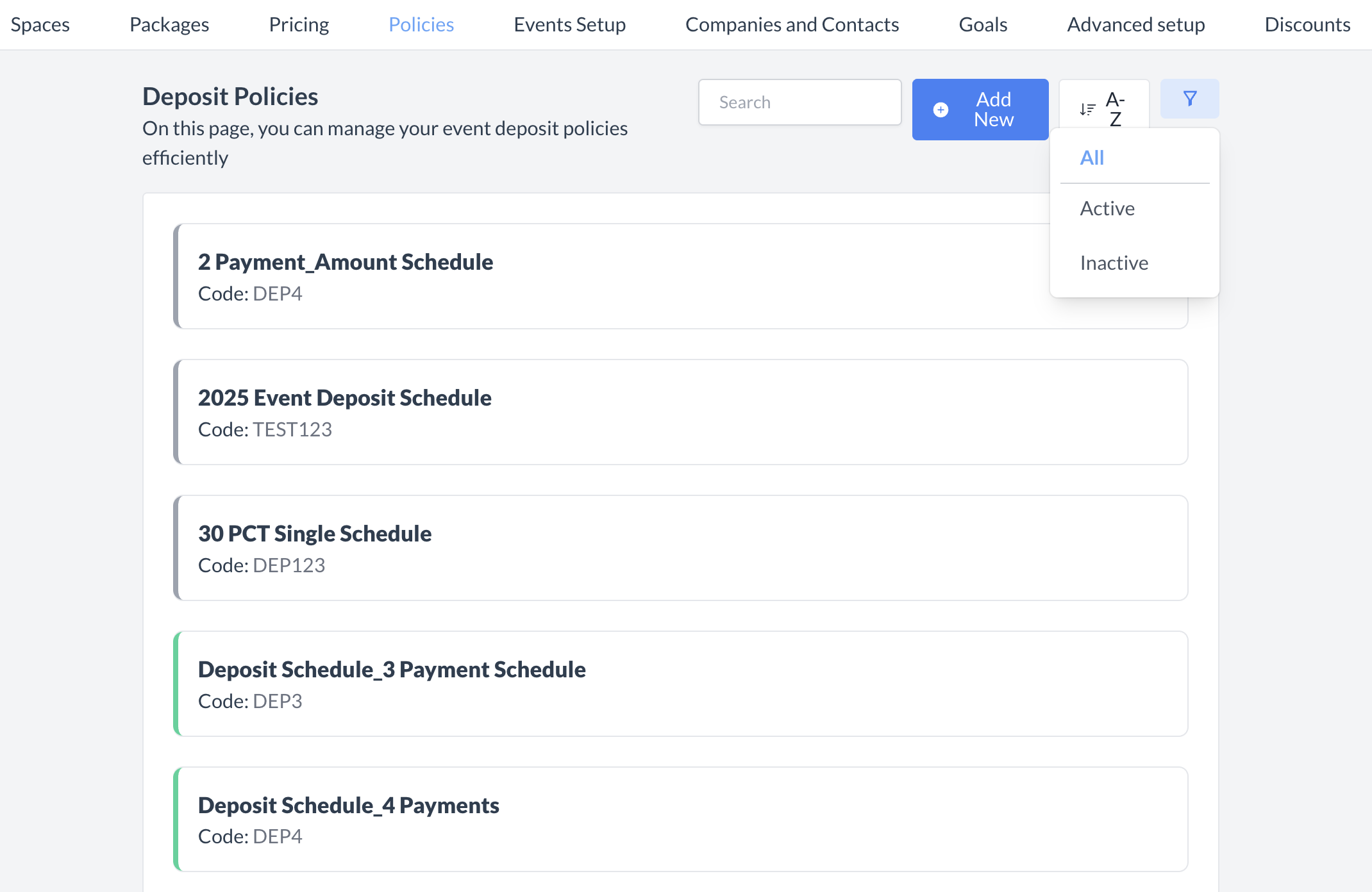
In the Deposit Policies directory, click the status filter dropdown and select Inactive (or All).
Locate the inactive policy (marked with a grey sidebar) and click to open.
In the header card, toggle the Inactive switch to Active (ON).
Instantly restores the policy with a green indicator bar, returning it to active selection menus across the event creation console.
📷 VISUAL CALLOUT:
Active vs. Inactive Policy Indicators & Filter Menu
Directory view comparing active policies (marked with a green vertical border) against inactive policies (marked with a grey vertical border), alongside the top-right status filter dropdown (All, Active, Inactive).
Active policies (marked with a green vertical border) and Inactive policies (marked with a grey vertical border)
Downstream UI & Operational Touchpoints
Once created and activated, Deposit Policies automatically populate across operational touchpoints in EventKey:
Event Creation Wizard (Step 4: Guarantee Information): Operators select the policy from the Advance Deposit Policy dropdown menu to assign deposit obligations during event booking.
Event Record (Reservation Console): On existing event records, the active policy appears under Guarantee Information. Clicking the Edit (pencil) icon allows authorized managers to modify or update the policy if contract terms are renegotiated.
Banquet Event Orders (BEOs): The calculated payment schedule prints in the Deposit Policy table on the BEO, detailing the specific Due Date and calculated Amount due.
Event Quotation Letters: The text entered in the Deposit Disclaimer field automatically formats under the Advance Deposit Policy section of quotation letters sent to prospective clients.