In EventKey, Event Auto Actions automate task generation and staff assignments based on predefined event milestones, timeline thresholds, or status changes. Rather than relying on manual reminders, the system continuously monitors event records against configured condition groups—such as elapsed days in tentative or prospect status, pending deposit values, or approaching start dates. When criteria are met, EventKey automatically generates and assigns structured action items to designated personnel (such as the Event Owner, Event Coordinator, or custom staff assignments). Automating task creation establishes team accountability, accelerates sales conversions, prevents contractual or deposit deadlines from slipping, and centralizes daily to-do items under Daily Task Management.
Operational Prerequisites
System Task Type AUTO_TASK Configuration:
⚠️ Mandatory System Prerequisite:
Before configuring Event Auto Actions, an Event Task Type named AUTO_TASK must be configured under Home > Event Administration > Events Setup > Event Task Type. This exact system task type is strictly required by the backend workflow engine to generate, route, and label automated tasks within the platform. Omission of this task type will prevent Auto Actions from generating tasks.
Configuration Guide: Creating an Event Auto Action
System Navigation Path
Home > Event Administration > Advanced Setup > Event Auto Actions > + Add New
Step
Action
Platform Guidance & Operational Details
Access Event Auto Actions
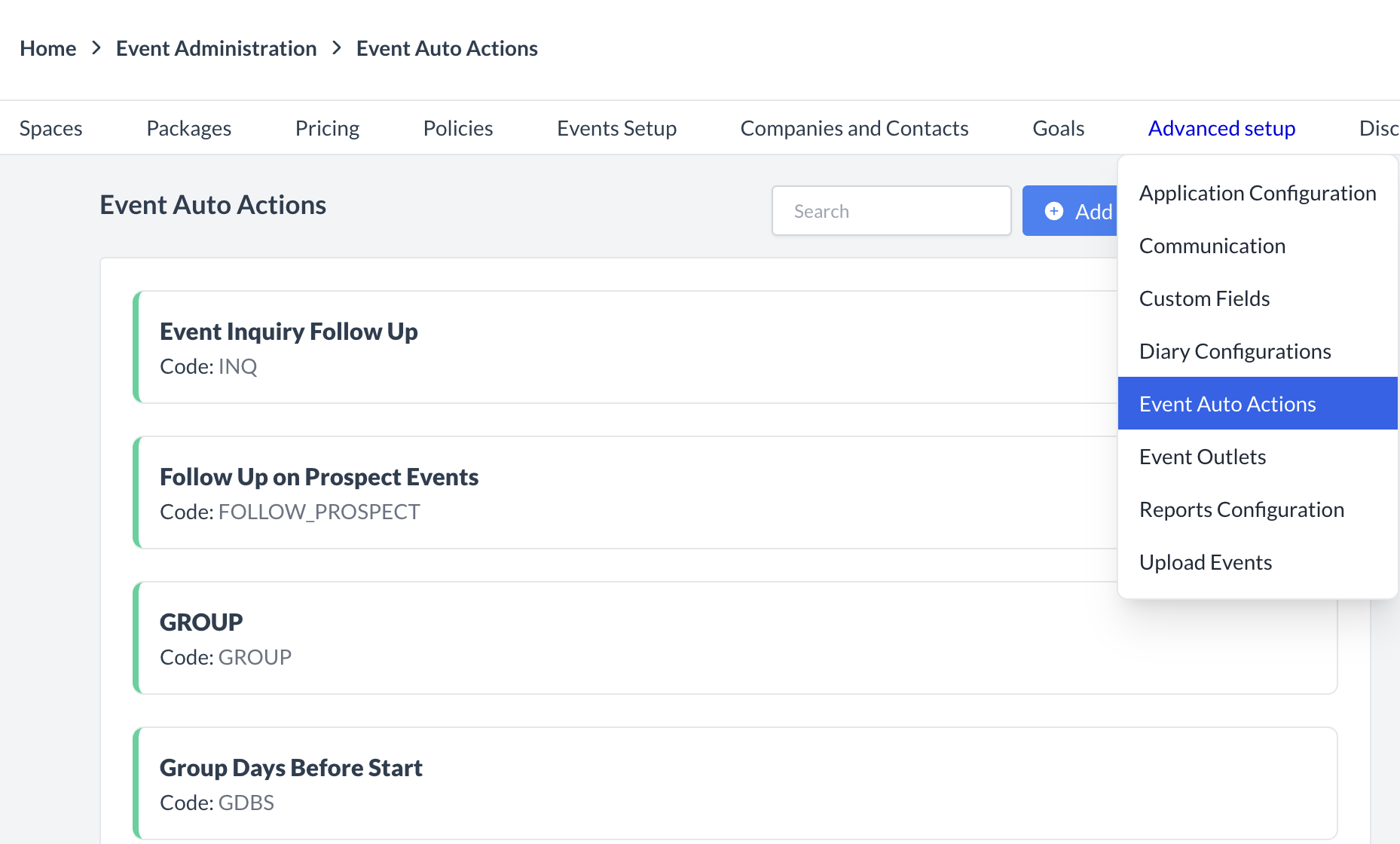
In EventKey Administration, hover over the Advanced Setup tab in the main navigation menu and click Event Auto Actions from the dropdown.
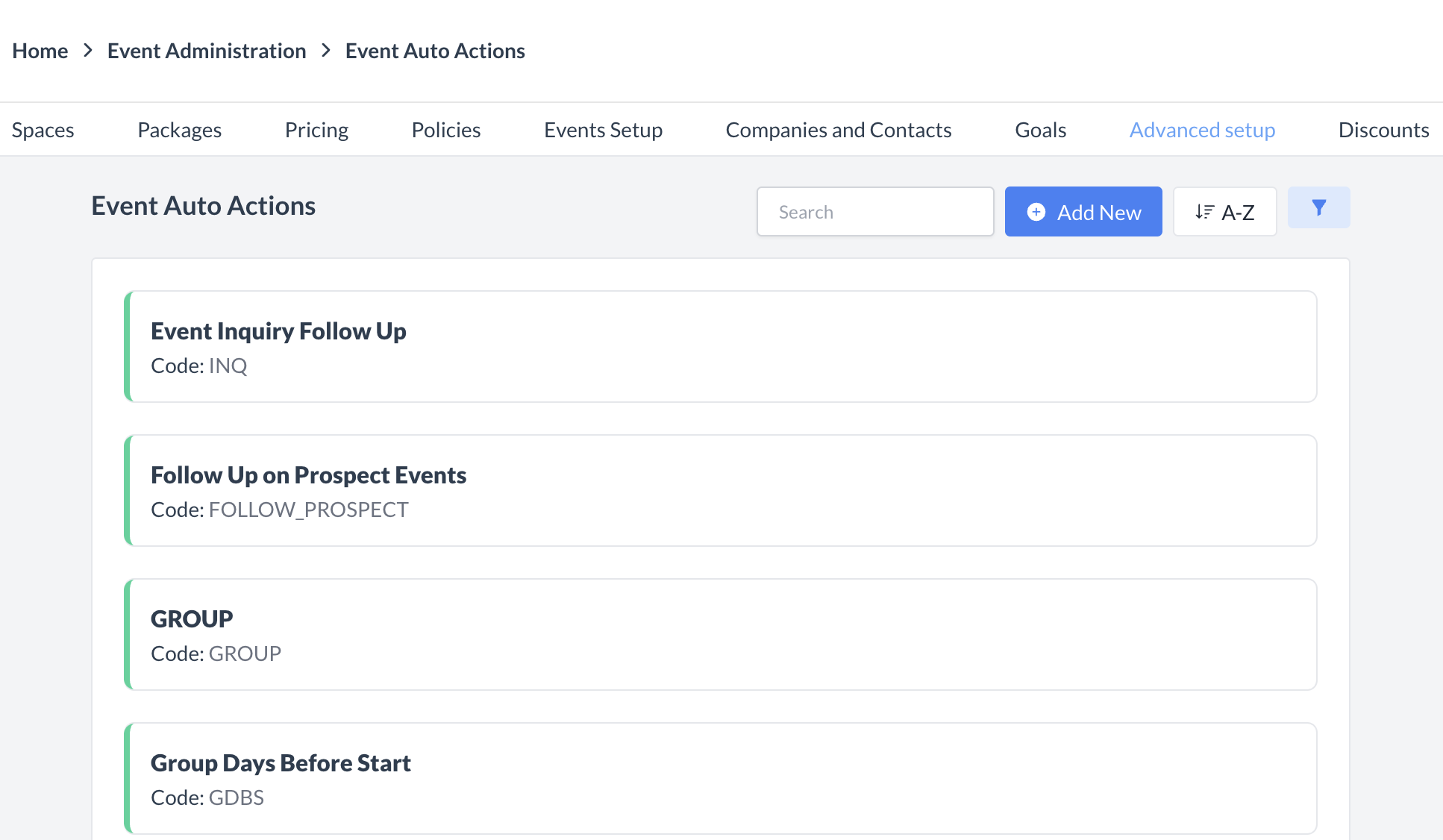
Opens the Event Auto Actions directory displaying active automation rules, codes, search query bar, sort controls, and action buttons.
Initiate Action Creation
Click the blue + Add New button located in the upper-right corner next to the search query bar and sort control.
Launches the Add Event Auto Action configuration console with the Active toggle enabled in the top-right header by default.
Enter Basic Information
In the Name input field, enter a descriptive title (e.g., Tentative Event Follow-up). In the Code field, enter a unique alphanumeric code or internal shorthand identifier (e.g., TEF).
Establishes the display title and unique system identifier used for administrative catalog management and auditing.
Select Assignee Type
Click the Assignee Type dropdown and select the operational role or team member responsible for executing the generated task (e.g., select Event Owner).
Options include Event Owner (assigns to the event's primary owner), Event Coordinator (assigns to all coordinators on the event file), or Custom (select specific personnel).
Define Action Notes
In the Action Notes text field, enter the clear instructional prompt that will appear as the "To Do" description when the task generates (e.g., Follow-up on Events with Tentative Status and outstanding contracts for 10 or more days).
Provides staff with explicit instructions and context directly on their daily task board.
Name Condition Group
In the Condition Groups container, enter a title in the Description field (e.g., Tentative Event Follow-up).
Identifies the logical rule grouping for this trigger set.
Configure Trigger Criteria
Configure the rule row:
Key: Select the metric trigger from the dropdown (e.g., DAYS_SINCE_TENTATIVE).
Operator: Select the mathematical evaluation operator (e.g., GREATER_OR_EQUAL).
Value: Enter the threshold number using the stepper or typing directly (e.g., 10).
Triggers task generation when an event has remained in Tentative status for 10 or more consecutive days. (Optional: Click + Add Condition to add more criteria to this group, or + Add Condition Group to add alternative trigger sets).
Save & Deploy
Click the blue Save button in the lower-right corner of the configuration screen.
Validates entries, displays a green top-right notification banner (Saved Successfully: Updated successfully.), and publishes the auto action to the active directory.
📷 VISUAL CALLOUT:
Advanced Setup Dropdown & Event Auto Actions Directory
(Left) The Advanced Setup navigation dropdown menu displaying Application Configuration, Communication, Custom Fields, Diary Configurations, Event Auto Actions, Event Outlets, Reports Configuration, and Upload Events; (Right) The Event Auto Actions catalog featuring existing active cards (e.g., Event Inquiry Follow Up, Follow Up on Prospect Events, GROUP, Group Days Before Start, Internal Event Coordination), search box, sort controls (A-Z), and the blue + Add New button.
Advanced Setup Navigation Dropdown
Event Auto Actions Catalog
Detailed Screen & Field Breakdown
1. Add / Edit Event Auto Action Form Parameters
Breadcrumb Navigation: Displays system context (< Add Event Auto Action) with an interactive back arrow to exit without saving.
Active Status Toggle: Located in the upper-right corner; controls whether the automated rule engine actively scans and generates tasks based on these conditions.
Name Field*: Required single-line text input capturing the formal display title of the auto action (e.g., Tentative Event Follow-up, Internal Event Coordination, Event Inquiry Follow Up).
Code Field*: Required alphanumeric identifier used for system tracking and reporting (e.g., TEF, INQ, NEOC).
Assignee Type Dropdown*: Operational routing selector determining who receives the generated task:
Event Owner: Automatically assigns the generated task to the primary coordinator designated as the Event Owner on the reservation file.
Event Coordinator: Automatically assigns the task across all assigned Event Coordinators linked to the booking.
Custom: Opens an additional user selection dropdown enabling assignment to specific individual staff members.
Action Notes Field*: Instructional text input capturing the specific assignment directives displayed to the assignee (e.g., "Follow-up on Events with Tentative Status and outstanding contracts for 10 or more days").
📷 VISUAL CALLOUT:
Add Event Auto Action Configuration Walkthrough
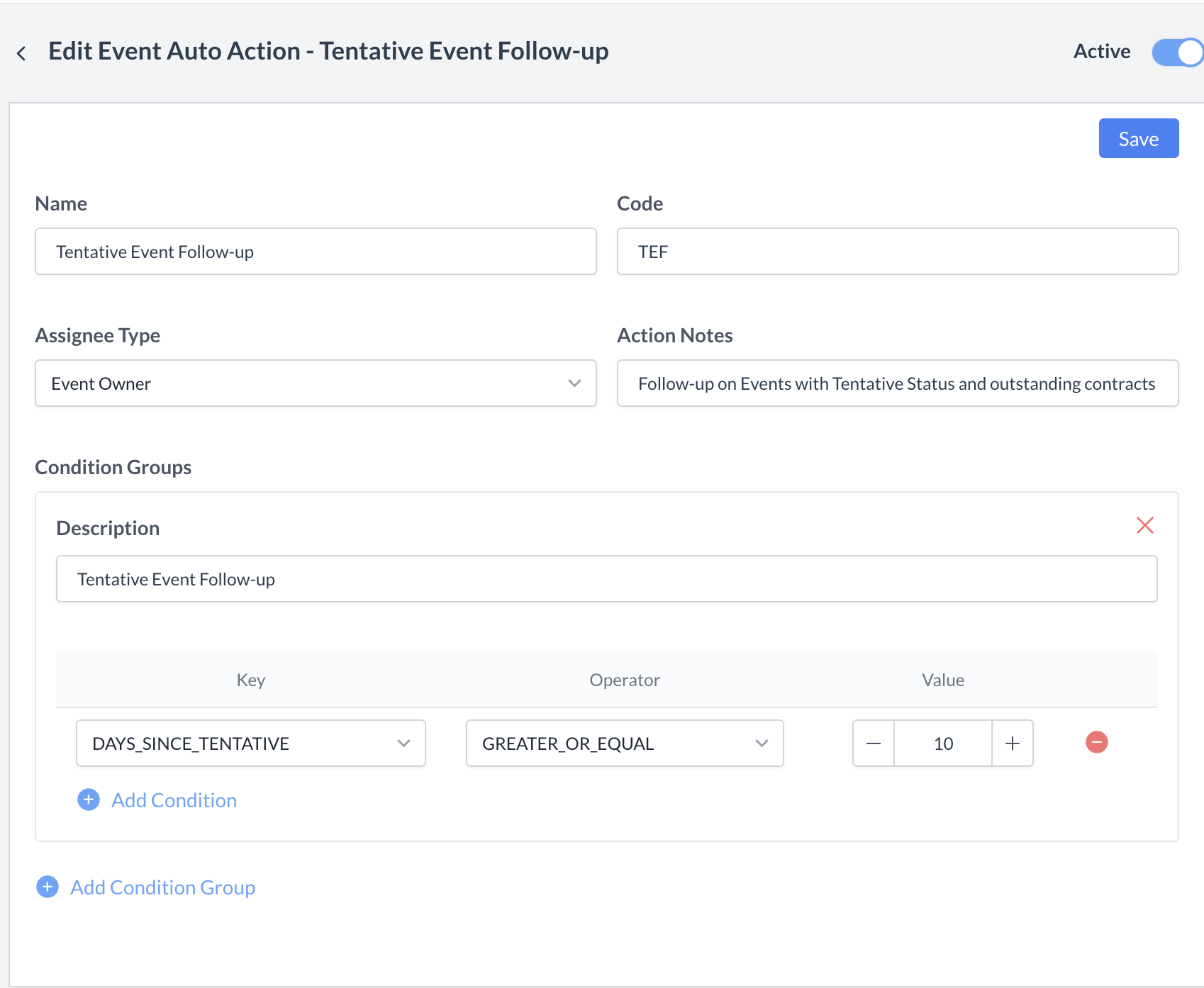
Form screen displaying Name (Tentative Event Follow-up), Code (TEF), Assignee Type (Event Owner), Action Notes populated with follow-up instructions, and the Condition Groups setup panel.
Event Auto Actions Configuration Walkthrough
2. Condition Groups & Trigger Logic Engine
Condition Group Description*: Header text field naming the rule set (e.g., Tentative Event Follow-up).
Remove Group Action (Red ✕): Discards the entire condition group container.
Trigger Key Dropdown*: System-monitored data point evaluated by the rules engine:
DAYS_BEFORE_STARTED — Days remaining until the event start date.
DAYS_SINCE_CANCELLED — Days elapsed since event cancellation.
DAYS_SINCE_CONFIRMED — Days elapsed since transitioning to Confirmed status.
DAYS_SINCE_ENDED — Days elapsed since event completion (useful for post-event surveys and billing follow-up).
DAYS_SINCE_INQUIRY — Days elapsed since initial inquiry creation.
DAYS_SINCE_PROSPECT — Days elapsed while in Prospect status.
DAYS_SINCE_STARTED — Days elapsed since the event began.
DAYS_SINCE_TENTATIVE — Days elapsed while in Tentative hold status.
EVENT_STATUS — Evaluates current lifecycle state (Prospect, Tentative, Confirmed, Cancelled).
GROUP_DAYS_BEFORE_STARTED — Days prior to sleeping room block arrival.
GROUP_DAYS_SINCE_ENDED — Days elapsed since sleeping room block departure.
Operator Dropdown*: Logical operator used for comparison:
EQUALS — Exact match.
GREATER_OR_EQUAL — Value is greater than or equal to threshold.
GREATER_THAN — Value exceeds threshold.
LESS_OR_EQUAL — Value is less than or equal to threshold.
LESS_THAN — Value is below threshold.
Value Field*: Numerical counter (- / +) or text entry defining the evaluation threshold (e.g., 10).
Delete Condition Action (Red Circle ✕): Removes an individual condition row from the group.
+ Add Condition Link: Appends an additional AND condition within the current group container (all conditions within the group must be satisfied).
+ Add Condition Group Link: Appends an additional OR container, allowing task triggers if either group's criteria are met.
📷 VISUAL CALLOUT:
Condition Group Setup: Key, Operator & Value Configuration
Detailed panel view showing Condition Description (Tentative Event Follow-up), Key set to DAYS_SINCE_TENTATIVE, Operator set to GREATER_OR_EQUAL, Value entered as 10, and the blue Save button.
Auto Action Configuration Screen
Managing Auto Action Availability: Inactivation & Reactivation
If a workflow rule is seasonal or temporarily paused, administrators can toggle its status without deleting historical records or previously generated tasks:
Workflow
Step-by-Step Procedure
System Impact
Inactivating an Auto Action
Navigate to Advanced Setup > Event Auto Actions.
Click on the target auto action card to enter edit mode.
In the upper-right corner, toggle the Active switch from ON to OFF.
The system automatically saves the update. The action receives a grey indicator bar and halts automated scanning and task generation immediately. Existing tasks already generated remain unaffected.
Reactivating an Auto Action
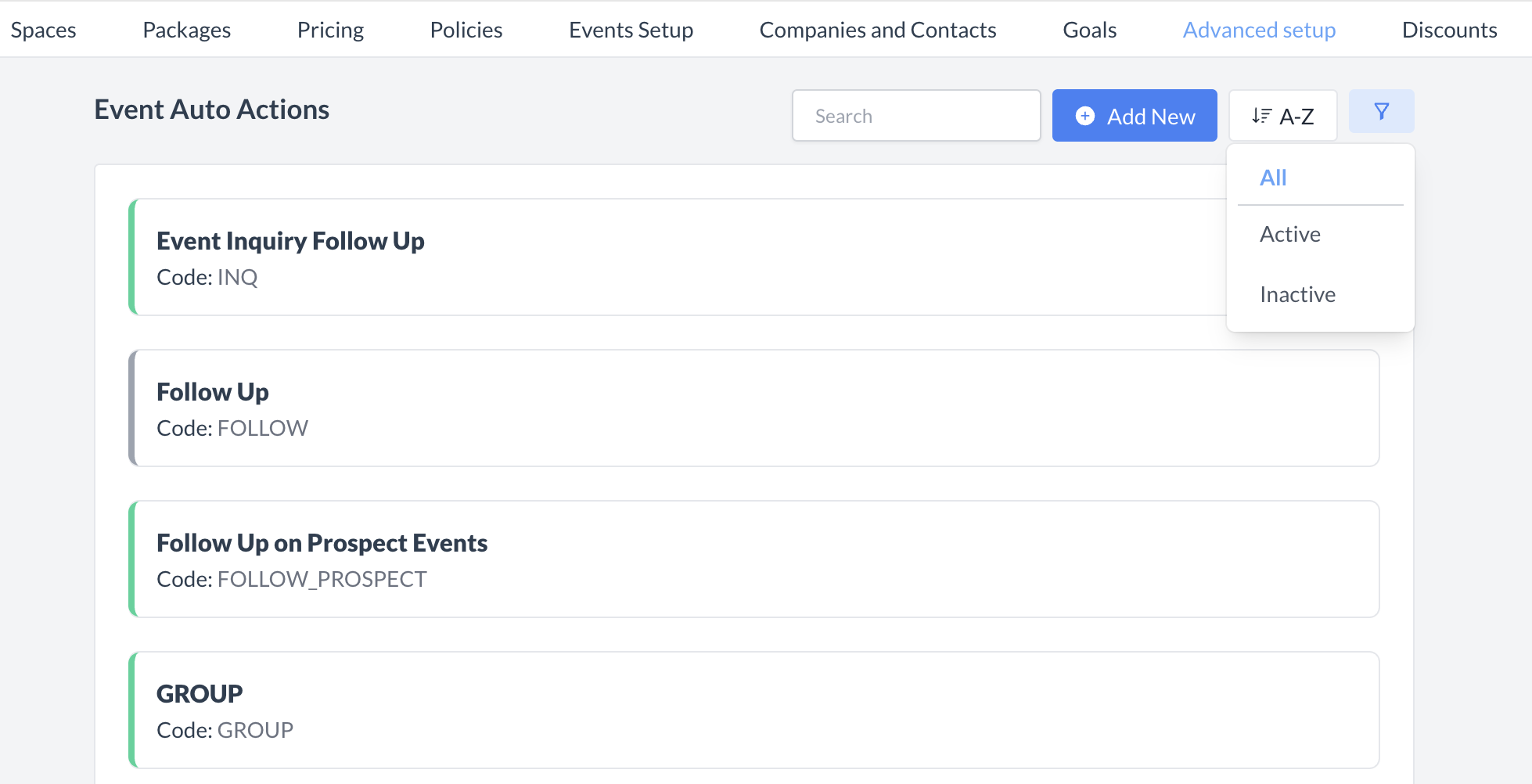
In the Event Auto Actions directory, click the status filter dropdown in the top-right header and select Inactive (or All).
Locate the inactive rule (marked with a grey sidebar) and click to open.
Toggle the header switch to Active (ON).
Instantly restores the rule with a green sidebar indicator, resuming automated condition monitoring and task creation on the next engine cycle.
📷 VISUAL CALLOUT:
Active vs. Inactive Auto Action Status Controls & Filter Menu
Directory view comparing active auto actions (green vertical sidebar) against inactive auto actions (grey vertical sidebar), alongside the top-right status filter dropdown (All, Active, Inactive).
Active auto actions (green vertical sidebar) and Inactive auto actions (grey vertical sidebar)
Downstream UI & Operational Integration
Once an Auto Action triggers, generated tasks populate into daily operational workflows across EventKey:
Daily Task Management Console: Automatically generated tasks appear under Daily Task Management flagged with Task Type: AUTO_TASK in open status.
Task Card Metadata: The generated item details the creation date, target Event Name (e.g., COPY OF HotelKey 2nd Quarter Meeting), assigned staff member (Assignee: James Fuller), company/contact links, and the configured Action Notes displayed as the actionable assignment.
Task Completion & Accountability: Assignees review, execute, and mark auto-tasks as completed directly from their daily dashboard or event task tab, providing sales leadership with clear visibility into follow-up response times and lead pipeline health.