In EventKey, the Banquet Event Order (BEO) generation workflow enables operational teams to compile, review, approve, version-control, and print comprehensive execution sheets for scheduled events. Serving as the official operational agreement between the property and the client, a BEO consolidates event timelines, function room arrangements, attendee guarantees, catering packages, audiovisual equipment, cancellation and deposit policies, and itemized billing schedules. Built-in BEO Version Control and approval lifecycle stages (Draft → Pending Review → Approved) ensure that internal teams review changes thoroughly before external distribution, while preserving historical approved versions whenever event specifications change.
BEO Versioning & Approval Lifecycle Rules
When Enable BEO Versions is active in Application Configuration, EventKey enforces strict version overwrite and status governance rules across BEO documents:
Overwrite Behavior Prior to Approval: Any newly generated BEO starts in Draft status. As long as the BEO remains in Draft or Pending Review status, generating a new BEO will overwrite the existing unapproved version rather than creating a separate version row.
Version Preservation Upon Approval: Once a BEO is transitioned to Approved status, that version is locked in the audit log. When subsequent changes occur on the event and a new BEO is generated, the system preserves the previously Approved BEO in the BEO Versions table and creates a new, sequential Draft version alongside it.
3-Stage Approval Progression:
Draft: Default initial status assigned when a BEO is first generated.
Pending Review: Internal staging status selected by the coordinator once details are ready for management or departmental verification.
Approved: Finalized internal sign-off status authorizing the document for external release.
Client Distribution Gatekeeper:Only BEOs in Approved status are eligible to be sent to the client for review and signature. Unapproved (Draft or Pending Review) BEOs cannot be dispatched through external client signing workflows.
Configuration & Workflow Guide: Generating, Approving & Versioning a BEO
System Navigation Path
Home > Event Management > Select Event Record > Actions > Print BEO
Step
Action
Platform Guidance & Operational Details
Access BEO Console
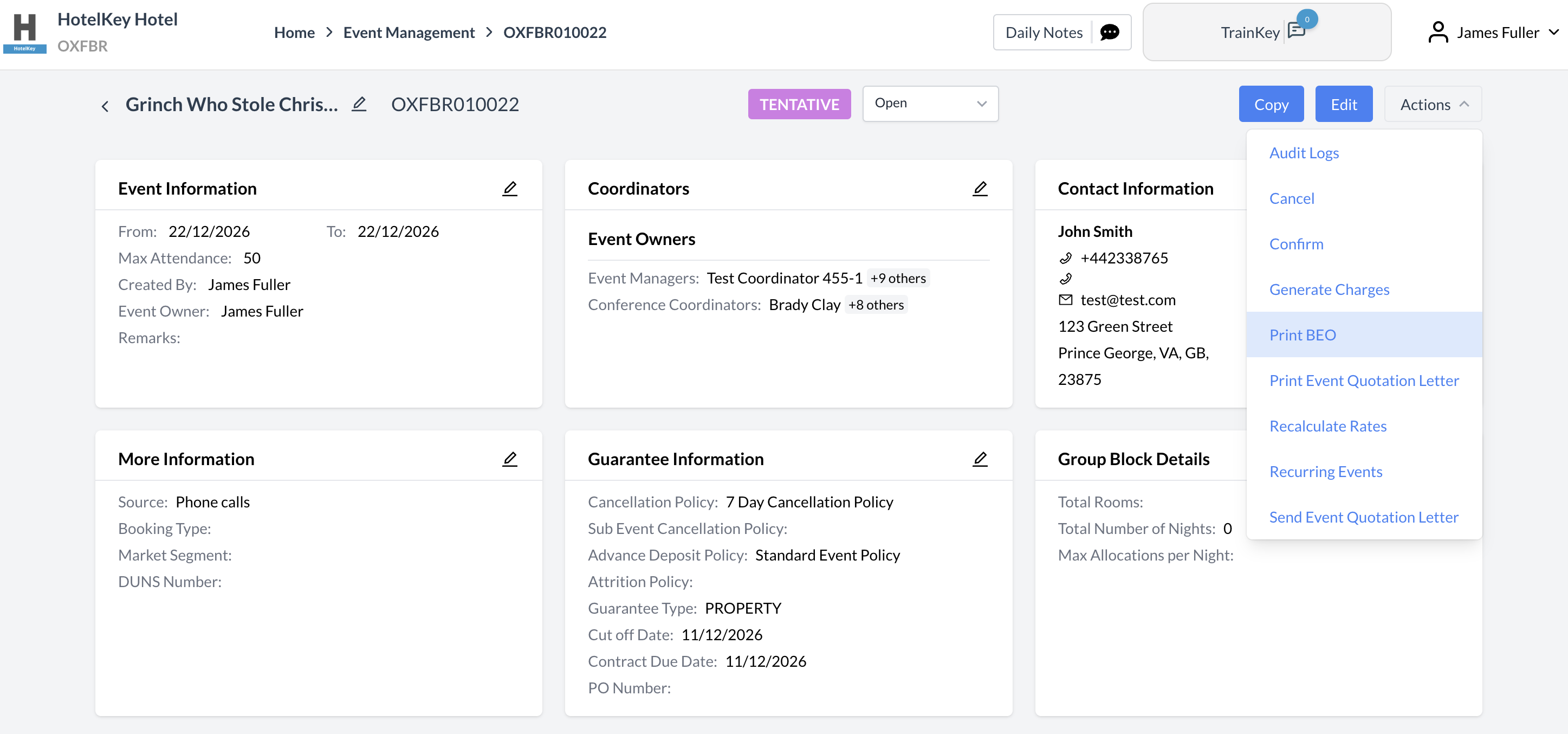
On the active Event Record (e.g., Grinch Who Stole Christmas, OXFBR010022), click the Actions dropdown in the upper-right header and select Print BEO.
Launches the BEO Versions overlay displaying existing version records, timestamps, approval statuses, and action buttons.
Initiate New BEO
Click the blue Create New BEO button in the lower-right corner of the BEO Versions modal.
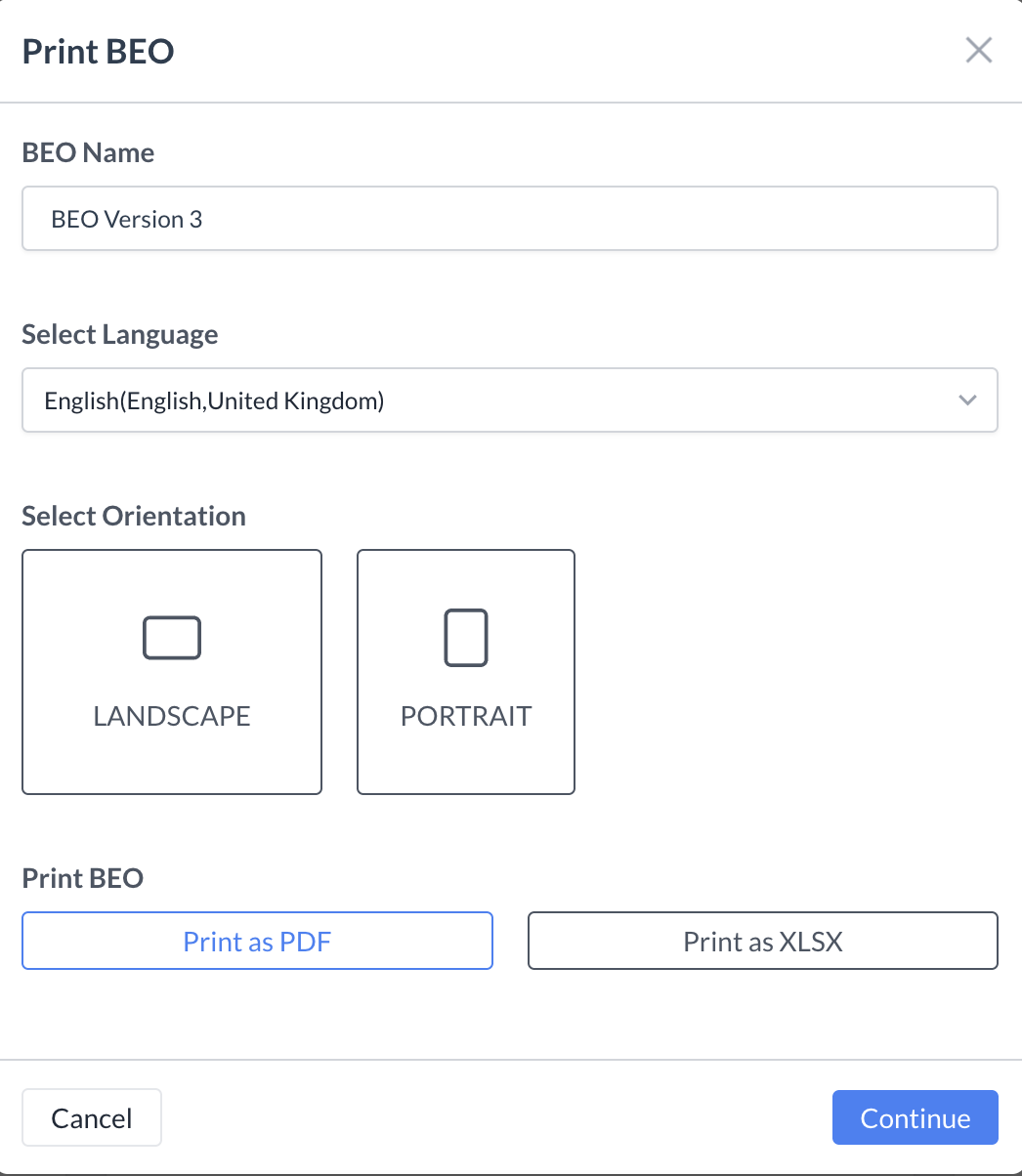
Opens the Print BEO layout and naming configuration modal.
Configure Layout & Naming
BEO Name: Accept the default sequential title (e.g., BEO Version 1) or enter a descriptive label.
Select Language: Choose the document language (e.g., English(English,United Kingdom) or English(English,United States)).
Select Orientation: Click LANDSCAPE or PORTRAIT.
Print BEO Format: Select Print as PDF or Print as XLSX.
Configures document formatting, page layout, and export file format. Click the blue Continue button.
Preview Generated BEO
The system compiles the BEO, opens the formatted document in a new browser tab, and logs BEO Version 1.pdf in the BEO Versions table with Draft status.
Review all event sections, policies, setup notes, amenities, and space/package charges for accuracy.
Advance to Pending Review
Return to the BEO Versions modal. Click the Edit (pencil) icon next to Draft in the Status column, open the status dropdown, and select Pending Review.
Updates the version status to Pending Review, signaling internal managers or department heads to audit the document.
Approve the BEO
Once internal review is complete, reopen Actions > Print BEO, click the Edit (pencil) icon next to Pending Review, select Approved from the dropdown, and close the modal (✕).
Locks BEO Version 1.pdf as Approved (green status badge) and unlocks client review and signature distribution.
Generate Revised Versions
After modifying event details (e.g., updating expected guest counts), reopen Actions > Print BEO and click Create New BEO. Enter a descriptive title (e.g., BEO Version 2.pdf) or enter a descriptive label, select layout options, and click Continue.
Preserves the ApprovedBEO Version 1.pdf in the version log and adds BEO Version 2.pdf (or descriptive label) in Draft status above it.
📷 VISUAL CALLOUT:
Event Record Actions Menu & Print BEO Configuration Modal
(Left) The Event Record header displaying the Actions dropdown menu with Print BEO highlighted; (Right) The Print BEO setup dialog showing BEO Name (BEO Version 3), Select Language, LANDSCAPE vs. PORTRAIT orientation cards, and Print as PDF / Print as XLSX options.
Event Record Actions Menu
BEO Configuration Modal
Detailed Screen & Field Breakdown
1. Print BEO Setup Modal Parameters
BEO Name*: Text input defaulting to sequential numbering (BEO Version 1, BEO Version 2). Supports custom descriptive suffixes (e.g., BEO Version 2 with Updated Expected Guest Count, BEO Version 2 with F&B) to clearly identify revision milestones.
Select Language Dropdown: Multi-language template selector supporting localized translations and regional date/currency conventions (English [United Kingdom], English [United States], Spanish, French, Italian, Japanese).
Select Orientation Cards:
LANDSCAPE: Horizontal layout suited for multi-column sub-event schedules, detailed remarks, and expansive billing grids.
PORTRAIT: Vertical layout suited for standard binder printing and single-column event summaries.
Print BEO Export Format:
Print as PDF: Generates a formatted, non-editable PDF preview in a new browser tab ideal for internal distribution, kitchen/banquet boards, and client signatures.
Print as XLSX: Exports tabular event data into an editable spreadsheet format for external reporting or custom internal formatting.
Continue Button (Blue): Compiles live event parameters into the document and records the entry in the BEO Versions table.
📷 VISUAL CALLOUT:
Generating a BEO in “Draft” Status Badge
Generating a BEO in Draft Status Badge
Status Column & Inline Editor:
Displays the current lifecycle status badge (Draft, Pending Review, or Approved in green).
Clicking the Edit (pencil) icon next to the status converts the badge into an interactive dropdown selector (Pending Review, Approved), automatically saving the transition upon selection.
📷 VISUAL CALLOUT:
Updating BEO Status to Pending Review
Updating BEO Status to Pending Review
Updating BEO Status to Approved
📷 VISUAL CALLOUT:
Updating BEO to Approved Status
2. BEO Versions Management Table
Version Preservation Upon Approval: Once a BEO is transitioned to Approved status, that version is locked in the audit log. When subsequent changes occur on the event and a new BEO is generated, the system preserves the previously Approved BEO in the BEO Versions table and creates a new, sequential Draft version alongside it.
Clicking Actions > Print BEO opens the BEO Versions modal displaying the complete revision audit trail:
BEO Name Column: Displays the saved filename and extension (e.g., BEO Version 2 with Updated Expected Guest Count.pdf, BEO Version 1.pdf).
Created At Column: Displays the exact date and timestamp when the document version was generated (e.g., 16/11/2026 10:05 am).
Status Column & Inline Editor:
Displays the current lifecycle status badge (Draft, Pending Review, or Approved in green).
Clicking the Edit (pencil) icon next to the status converts the badge into an interactive dropdown selector (Pending Review, Approved), automatically saving the transition upon selection.
Action Column (Print Button): Blue Print button on each row that immediately opens that specific historical or active BEO version in a new browser tab for viewing, downloading, or printing.
Create New BEO Button (Blue): Initiates a new document generation cycle. (Remember: Overwrites the current row if status is Draft or Pending Review; appends a new version row if the previous version is Approved).
📷 VISUAL CALLOUT:
Generating New BEO & Version Management
Generating New BEO & Version Management
3. Generated Banquet Event Order (BEO) Document Structure
The compiled BEO PDF organizes all event parameters into standardized operational sections:
Document Header: Property branding logo, address, BEO # / Confirmation Number (e.g., OXFBR010022), Status (TENTATIVE / CONFIRMED), and Cut Off Date.
Contractual Policy Tables: Displays Event Cancellation Policy (Period Range, Percentage, Fee, Fee Type) and Deposit Policy (Due Date, Amount) based on active Reports Configuration settings.
Sub-Events Schedule & Setup Instructions:
Master schedule table detailing Date, Time, Space, Sub-Event Name, Pricing model, and Expected / Guaranteed / Actual guest counts.
Detailed setup blocks including Setup Time / Teardown Time, Space Arrangement, Space Description, Space Remarks, and Standard Event Amenities.
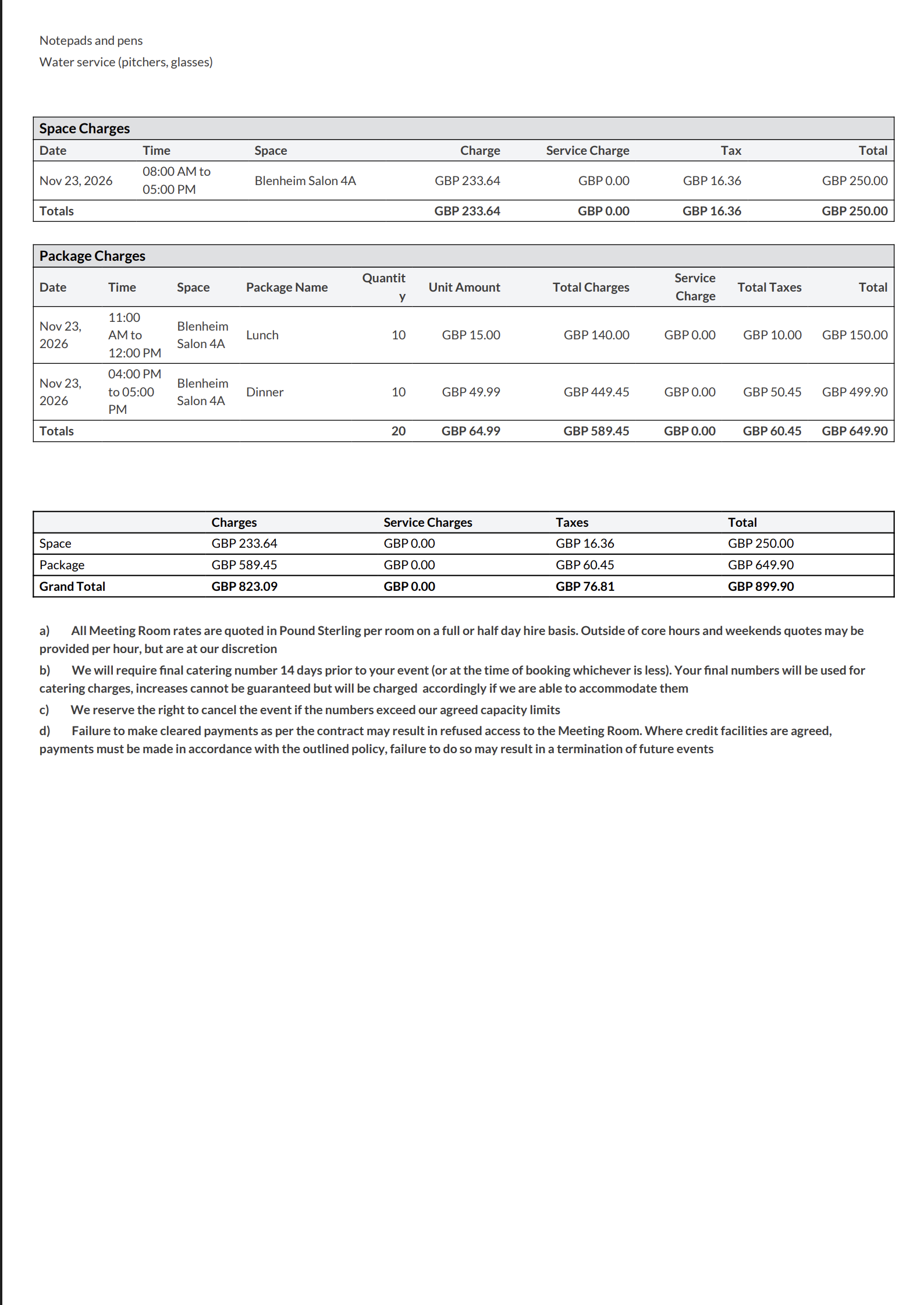
Financial & Billing Summaries: Itemized Space Charges, Package Charges, Taxes, Service Charges, and Grand Total summary tables, followed by property terms and conditions.
📷 VISUAL CALLOUT:
Generated Banquet Event Order (BEO) PDF Output
Multi-page BEO PDF preview displaying the property header, Event Cancellation Policy table, Sub-Events schedule grid, Setup Instructions, Standard Event Amenities checklist, and itemized Space and Package Charges.